A Hobby With Invoices: Trying to Turn a 3D Printing Side Business Into a Busier One
The goal is more enquiries, and more of them becoming orders. Search and regular social posts are how I'm going after it, and the social half needed an app. It's too early to say if it works.

My 3D printing business gets a couple of enquiries a week. I want more of them, and more of them becoming orders, so the printers stay busy. I’m not there yet, so this is what I’ve tried so far.
TL;DR
G3DK Printing is my one-person 3D printing business in Western Sydney. The order system works well, but it doesn’t get used often enough: a couple of enquiries turn up each week, and not all of them become orders. I’d like more enquiries, and more of them converting, so the printers stay busy.
So I’m working on two things: being findable on Google, and posting real photos of my prints regularly. The first has its foundations in place. The second needed an app, which Claude and I built after three days of research.
I haven’t hit the goal, and I can’t yet say whether any of this helps. I’ll know more in December.
The goal
In September I built an order portal that takes an enquiry all the way to delivery. It’s good at its job, and it could use more practice. A couple of enquiries a week, not all of which become orders, is still closer to a hobby with invoices than a business.
So the goal has two parts: more enquiries, and more of them turning into orders, so the printers stay busy. Same collaborator, same principle: I supply direction, the agent supplies execution. The direction this time was about customers rather than code.
The first job was making it countable. Google Analytics couldn’t tell me who asked for a quote, because the form never loads a new page. Netlify’s analytics reported 10,742 pageviews for September, which looked great until 9,502 of them turned out to be from the United States, a steady 320 or so a day hitting the homepage. Australia accounted for 311.
So Google’s tracking came off, Cloudflare’s cookie-free analytics went on, and every enquiry now records where the person came from. A tagged link tells me which channel sent them.
Lesson: Before you try to grow a number, check you can see it. Mine was mostly robots.
Search: the foundations
The basics went in on 29 September: Search Console and Bing Webmaster Tools, a generated sitemap, structured data with the real service area, a verified Google Business Profile, and a review request when an order finishes. I skipped Apple Maps because a listing would have published my home address.
Then the first month’s numbers came in, 28 September to 27 October: 10 clicks and 114 impressions, mostly from people who already knew the name. For “3d print sydney” the site sat at position 91. Only five pages were indexed, and the price finder, the page that turns visitors into enquiries, wasn’t one of them. There were 3 Google reviews.
Social: why it needed an app
The first attempt was local Facebook groups. I joined five and wrote an introduction fitted to each one’s rules. One post was declined without a reason, and another vanished from the queue. I gave up on them on 30 October.
That left posting regularly on my own Page and Instagram, which had 3 posts and 1 follower. I don’t expect Instagram to be the main source of orders. It’s proof of real work for locals who look me up, and every post also adds real photos to the website, which helps search. But it only works if it’s regular, and by hand it wasn’t going to be: a caption per channel, a queue topped up monthly because Facebook’s scheduler only reaches 29 days ahead, and hundreds of photos sitting in a library. My plan allows about an hour a week for all of this.
Paid ads weren’t the shortcut either. On my rough numbers an order could cost $25 to $150 in clicks, against a $20 minimum order.
Three days of finding out, one evening of building
We started on 27 October without writing any code. Each finding removed a choice:
- Google Photos was out. Since March 2025 its API only reads photos the calling app created, so the source became Immich, my self-hosted photo library.
- Immich could do the job, but it held the same photo up to three times, so the app had to remove duplicates.
- My originals carry GPS for our house. Immich’s previews don’t, and they’re big enough for Instagram.
- Instagram fetches each image from a public URL, which a home server doesn’t have, so the website hosts the files.
- Meta’s recommended login didn’t work for us. Its tokens reached no Instagram account. We lost two days to it, then went back to the older Facebook Login.
By 30 October there was very little left to decide, and the build shows it:
- 5:15 pm Website side committed.
- 6:07 pm First commit of the app.
- 6:41 pm Running in a small container at home.
- 8:35 pm Facebook, Instagram and the scheduler committed.
- 8:46 pm First real post sent, and confirmed by reading it back a minute later.
That’s three and a half hours from first commit to first post. It went quickly because nobody had to stop and work out what to do. My part was working through it with Claude, testing each stage and catching what only a person looking would catch, like the photos ignoring my trims.
The jobs that stayed mine
Anything inside my own accounts. I created the Meta app, generated the first token, clicked the button that took it live, and made the Immich key and the sign-in client. Claude took it from there without printing the secrets.
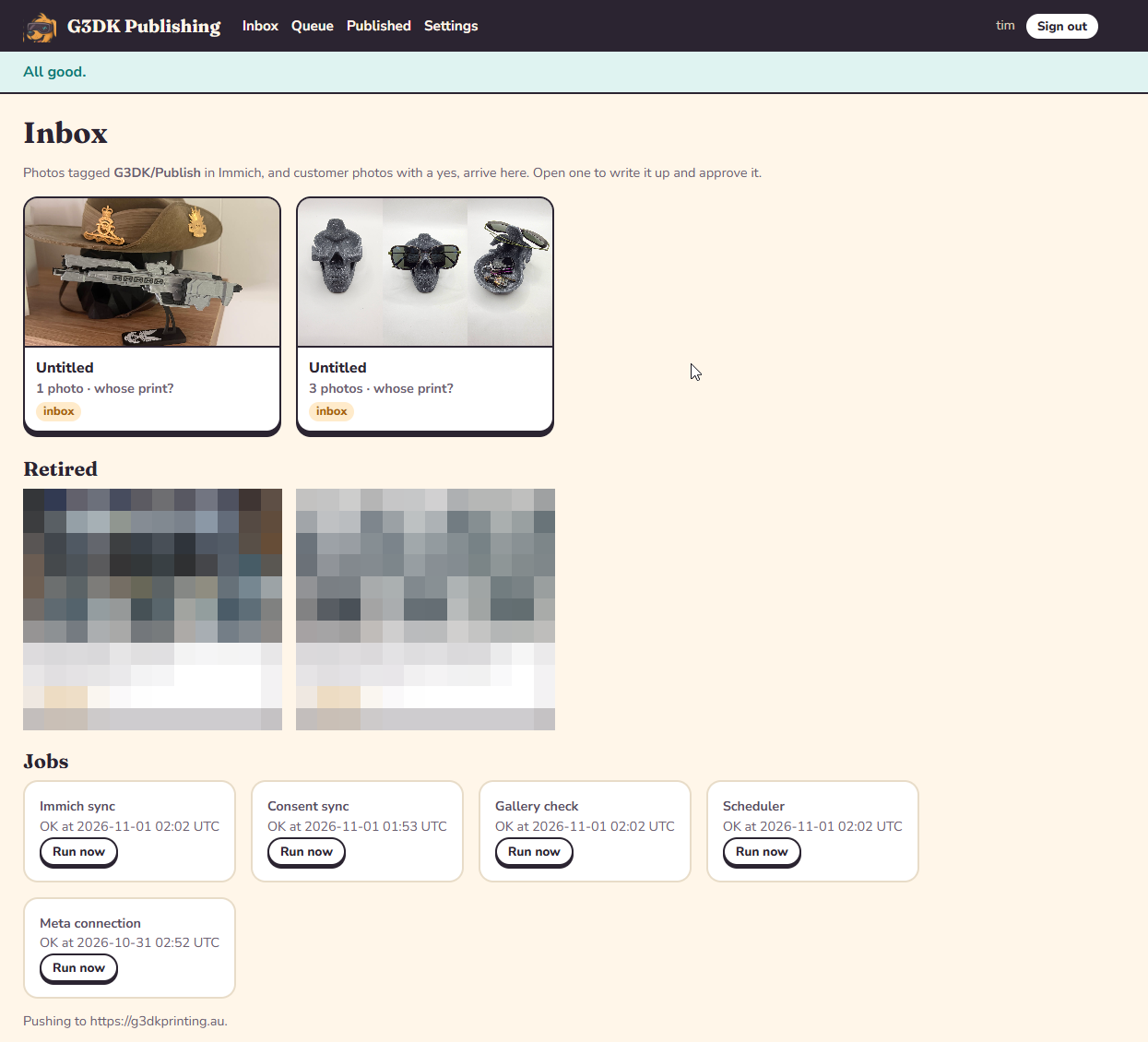
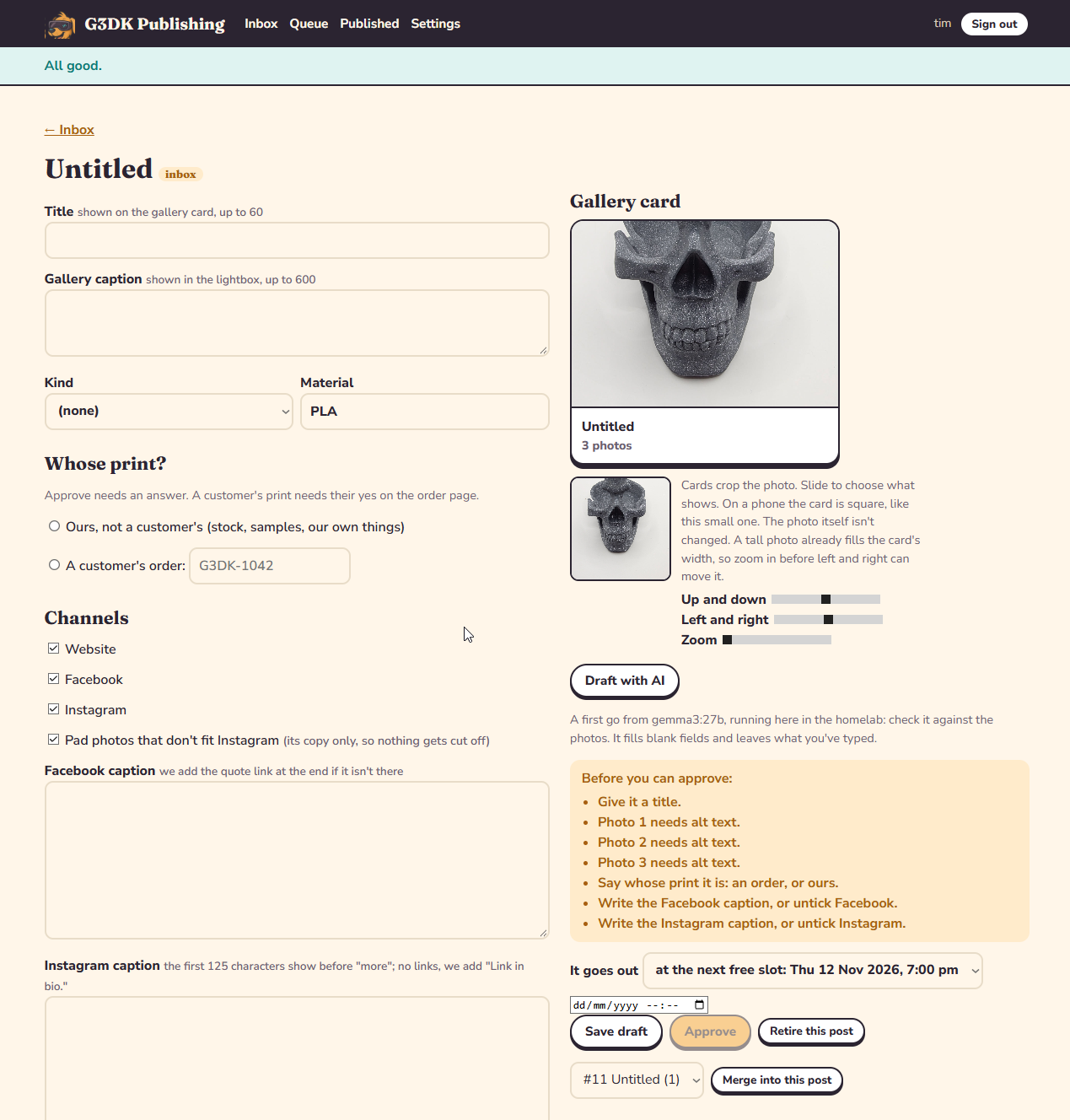
Approve. Claude connects over MCP, the protocol that lets an AI use a tool directly, and gets six tools: list posts, read a post, look at a photo, update a draft, check the copy, see the queue. It has nothing to approve, publish or delete with, and a test fails if anyone adds a tool. Customers’ photos go through the same gate, and only if they said yes on their own order page.
Deciding what should go out. That’s the one I got wrong. Less than an hour after the first post, I approved a resin miniature for Sunday. Five minutes later it was clear the model closely matched a famous tabletop miniature, from a company I have no wish to hear from. I stopped Facebook and Instagram in time, but Approve had already put it on the website, where it stayed for about six minutes. Less than an hour later, Approve stopped publishing anything: now everything goes public together at the chosen time.
Claude got one wrong too, telling me a figure’s hair clip had a swastika sculpted into it. I looked at the print, and it’s a skull with a lightning-bolt crack.
Licences are the same kind of call. Most of the queued posts use models whose licence restricts commercial use without permission. Claude advised holding them, and I chose to post my own prints as showcases, with credit to each designer, knowing the risk.
Lesson: Let the agent do everything up to the decision, and make the place it stops obvious. Then check what your own buttons really do.
Where it stands
- Enquiries and orders: no change I can claim. It’s a couple of enquiries a week, and more of them, converting better, is still the goal, not a result.
- Social: two posts out, and five queued from 1 to 10 November. Three slots a week now, where the old routine was one.
- Measuring: tagged links on the Facebook posts and the Instagram bio. The first proper check is in early December, across Search Console, the Business Profile, where enquiries came from and how many became orders. Anything that shows nothing after two monthly checks gets dropped.
The honest part
The app was the most fun and the quickest part, and it’s the part an agent is good at. But nobody ever enquired about a 3D print because of a well-designed approval gate.
What’s left is slower and mostly mine: choosing the photos, deciding what should go out, and waiting to see if anyone notices. No agent can speed up that last part. What the agent did change is the cost of trying. Three days of research and an evening of building is cheap enough to find out, and if the December numbers say it didn’t help, I’ll drop it and try something else.
More enquiries, more of them becoming orders and busy printers are still the goal. Ask me in December.
Under the hood
What it runs on
- Search Console and Cloudflare Web Analytics, plus
utm_tags kept with each enquiry. - FastAPI 0.162.0, Jinja, HTMX and SQLite, in a small Debian container on Proxmox.
- Immich v3.3.5 for the photos, with tags choosing what’s used.
- Pillow 13.0.0 to re-encode every file with no metadata.
- MCP Python SDK 2.3.0 for the agent’s tools.
- Meta’s Instagram publishing and Page photos APIs.
- Netlify Blobs for the gallery and public image files.
Decisions
- Count enquiries in your own database. They’re the number that matters, and no analytics tool sees them as well.
- The tool list is the guard, not a prompt. A tool that doesn’t exist can’t be called.
- Approve uploads but doesn’t publish, unless the post is website-only.
- A post is
confirmedonly by a later read, never by the response to sending it. - A customer’s consent is re-read just before sending, and unknown doesn’t count as yes.
Gotchas
- Immich previews ignore your trims unless you add
&edited=true. - Meta shows media posts only to the app’s developers and testers until the app goes Live.
- Approve took 44 seconds. It wasn’t the CPU or the upload speed: the website takes about a second to store each file. Eighteen files took 27.8 seconds one at a time and 7.3 seconds four at a time.
G3DK Printing: g3dkprinting.au. Send a model link, get a price.